
1. Teach mothers breastfeeding technique prior to delivery
Mothers can be taught breastfeeding technique, latch, positioning through video instruction prior to delivery. Mothers can also be taught manual expression of colostrum and pumping in the event of missed feeds due to mother-baby separation
2. Counsel and Review the Mother’s Feeding plan
Evaluate and counsel mother on risk factors for late onset or insufficient breast milk production and plans for supplementation to avoid hospitalization and health risks to her newborn if breast milk is delayed or insufficient. Evaluate and respect the mother’s values and wishes to avoid risks to her newborn’s brain and health. Provide judgment-free support for her infant feeding goals.
3. Informed consent of risks of insufficient feeding
Parents have a legal right to information on the risk of brain injury, disability and rare death from insufficient feeding of infants and the clinical signs of excessive jaundice, dehydration, hypoglycemia and hypernatremia. Providing patients information on the signs and consequences of insufficient feeding and a plan to prevent these complications with rescue supplementation while maintaining breast milk supply can protect a child from serious and irreversible outcomes.
4. Breastfeed within 1 hour with confirmed transfer of colostrum
Give instruction during first feeding on latch, safe positioning, hearing of swallows.
5. Universal screening of glucose within 1 hour of birth
Universal screening of glucose within 1 hour of birth and ongoing screening for newborns who are at risk of hypoglycemia or not receiving ad-lib supplementation or the full daily requirement of > 100-120 Cal/kg/day or > 6 oz/kg/day (breast milk and/or formula) can prevent unsafe levels of hypoglycemia that can impair brain development. Deleterious levels of hypoglycemia (< 45 mg/dL) have been documented within the first hours of life and have been associated with lower academic achievement, even when corrected.
6. Avoid low blood sugar or hypoglycemia < 50-60 mg/dL
The Pediatric Endocrine Society recommends glucose levels no lower than 50 mg/dL in the first 48 hours and no lower than 60 mg/dL thereafter, particularly for high risk newborns, which now include exclusively breastfed newborns. Glucose levels < 45 mg/dL, even early transitional hypoglycemia, have been associated with permanent declines in long-term academic achievement. If lactogenesis II has not occurred, supplement to satisfaction or provide > 6 oz/kg/day to restore caloric reserve and stabilize serum glucose in newborns at or near the hypoglycemia threshold.
7. Every 12 hour weight checks
Healthy, term exclusively breastfed newborns can lose 7-8% of their birth weight in 24 hours. Every 12 hour weight checks captures the newborns at highest risk of complications from excessive weight loss within the first 24 hours and can signal need for supplementation for newborns with > 75%ile weight loss, particularly those showing signs of persistent hunger and distress.
8. Minimum of daily bilirubin checks in EBF newborns
Daily transcutaneous or serum bilirubin checks should be obtained in all EBF newborns until the full daily nutritional requirement is met with onset of daily weight gain. Bilirubin levels are expected to increase until the onset of lactogenesis II occurs and exclusive breastfeeding is capable of providing the full requirement of > 6 oz/kg/day.
9. Supplement breastfeeding before reaching the hyperbilirubinemia, hypernatremia and hypoglycemia threshold to Protect the Newborn Brain
- Supplement before reaching the phototherapy threshold for hyperbilirubinemia or bilirubin > 15 mg/dL as developing the diagnosis of hyperbilirubinemia and/or need for phototherapy has been associated with increased risk of brain injury, ADHD, seizure disorder, Bilirubin-Induced Neurological Disorder or Chronic Bilirubin Encephalopathy.
- Supplement upon reaching the hypernatremia threshold of > 145 mEq/L. Greater than 50% of newborns with sodium levels of >150 meQ/L have abnormal developmental scores by 12 months of age.
- Supplement before reaching hypoglycemia threshold of < 50 mg/dL (first 48 hours) and < 60 mg/dL (after 48 hours)
- The newborn stomach is approximately 20 mL at birth and supplementation can be provided 15 mL at a time until satisfaction to allow the newborn to self-correct metabolic abnormalities unless lethargic (commonly 30-60 mL if newborn is depleted)
10. Check sodium levels at > 5% weight loss in EBF newborns
Check sodium levels at 5% weight loss or in distressed newborns given increased risk of hypernatremia in such newborns. If lactogenesis II has not occurred or there is ongoing weight loss, supplement with pumped milk, donor milk or formula to correct sodium levels 145-150 mEq/L to infant satisfaction and/or correction of sodium (typically 30-60 mL per feeding). Sodium levels > 150 mEq/L require parenteral management in intensive care setting.
11. Teach health care staff signs of newborn distress from insufficient feeding
Teach and distribute the HUNGRY infographic for signs of hypoglycemia, hypernatremia, dehydration and jaundice in newborns, which should signal nurse- or doctor-initiated checks for glucose, bilirubin, sodium and weight loss percent.
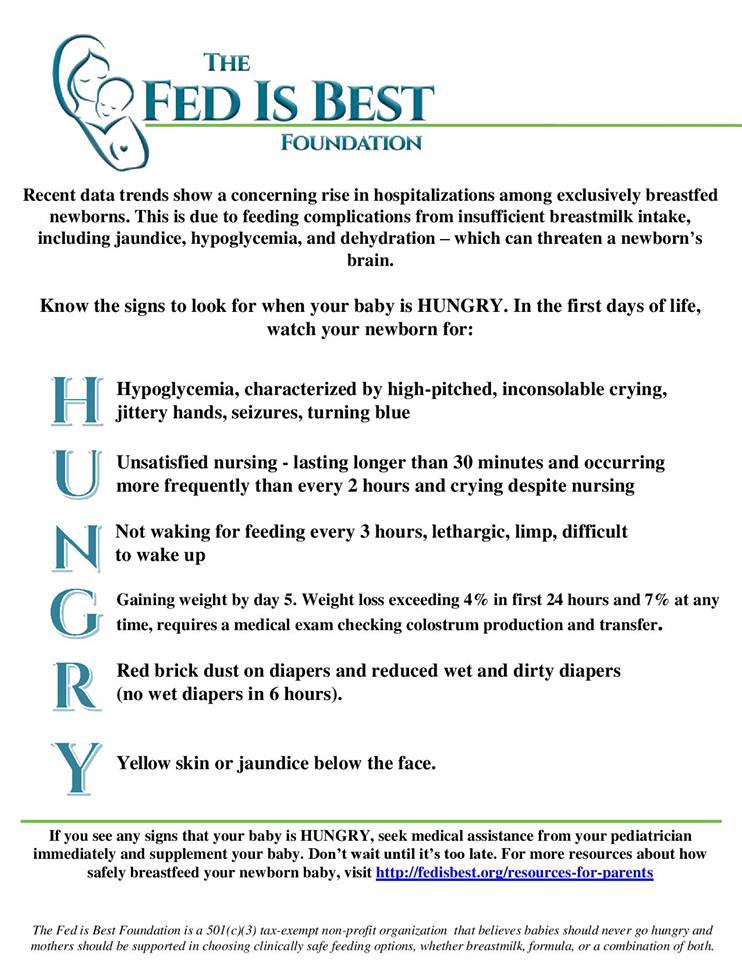
12. Check weight loss percent, glucose, sodium and bilirubin levels in distressed EBF newborns and before discharge
Do not discharge if values are approaching abnormal values of:
-
- Weight loss > 7% (unless a supplementation plan is in place)
- Glucose < 60 mg/dL
- Sodium > 145 mEq/L
- Bilirubin in high-intermediate risk zone or approaching 15 mg/dL
13. Teach mothers the signs of newborn distress from insufficient feeding
Teach mothers the signs of newborn distress from insufficient feeding (HUNGRY) and plan for supplementation to prevent excessive weight loss, hyperbilirubinemia, hypoglycemia and hypernatremia after discharge, particularly if lactogenesis II has not occurred. Teach every 12 hour weight check with home baby scale until onset of daily weight gain and provide calculated 7% weight loss threshold to avoid at home as greater than 7% weight loss increases the risk of hyperbilirubinemia and hypernatremia.
14. Provided ongoing inpatient monitoring or next day follow-up for exclusively breastfed newborns if onset of lactogenesis II has not occurred
Next day follow-up with universal bilirubin, glucose, sodium and weight check should be offered as the post-discharge period is the highest risk time for developing feeding complications. Evaluate for signs of newborn distress, lethargy and milk transfer with weighted feeds. Counsel parent(s) on lab values and percent weight loss and offer supportive counseling on breastfeeding technique and supplementation if needed. Emphasize brain-protective role of supplementation and the importance of protecting the newborn from hunger and thirst.
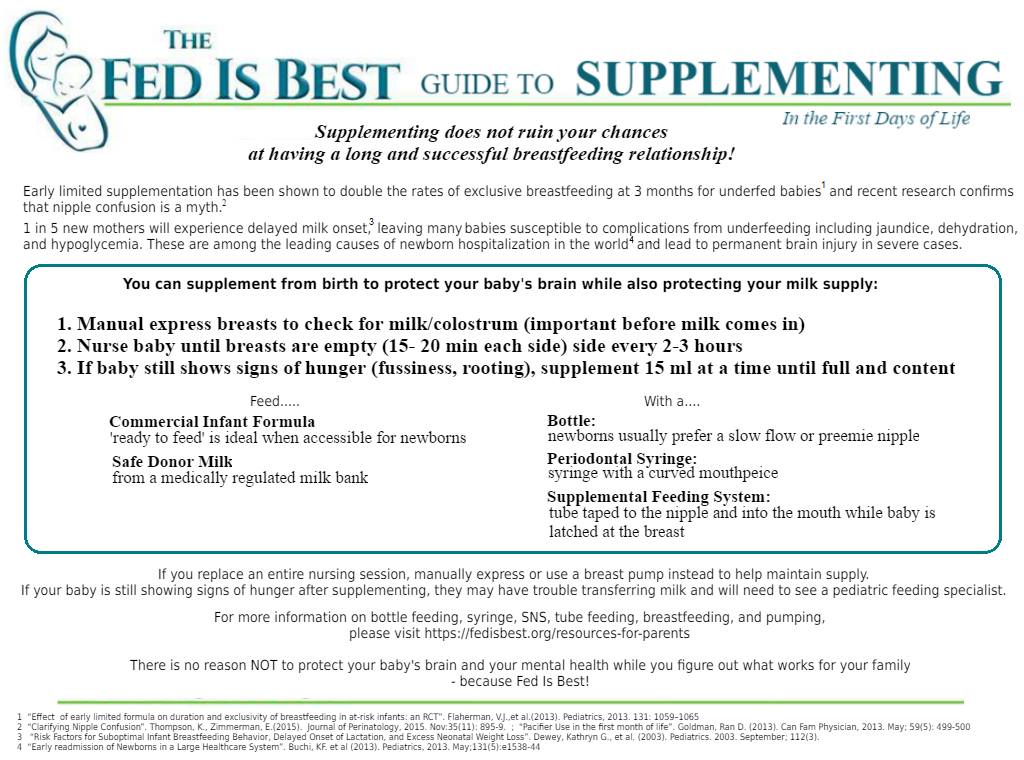
Please watch the following video presentation: “Making Sure Your Newborn is Sufficiently Fed”
nbsp;